Posts Tagged “Cloud Computing”

Cloud is better off without Flash

by Ali. 1 Comment

With the emergence of the iPad, there are many trends changing and many ideas developing around an old but finally well-developed phenomenon: the tablet computer.

Although I am somehow late giving my opinion on the subject, I think it is worth the try.

One of the areas cloud computing can be very useful and extremely capable is on the thin clients. Despite the fact that definition of a thin client nowadays is quite different than few years ago (take iPad and compare it to any of the “revolutionary” J2ME enabled devices) they are still far less capable than conventional computers, i.e. laptops and desktops.

iPad (as a good example and so far the best in the segment) is fairly powerful by itself and offers decent performance in doing resource-intensive tasks like 3D game rendering. But there are times that its processing power and storage capacity is not sufficient for certain tasks. You might say, well turn to a more powerful computer then. The price of such move could be sacrificing the super cool and useful features like ultra-portability and modern human user interface of the iPad.

government,politics news,politics news,politics

Globalizing Clouds, Geopolitically Speaking

by Ali. 0 Comments

This article was originally posted on CloudAve.

Security remains as one of the biggest challenges in adopting and spreading cloud computing. But there is an even bigger concern that could threaten the existence of clouds in a bigger picture.

Read the story to find out what this threat is and what could be done about it.

government,politics news,politics news,politics

Develop Google AppEngine with Aptana Studio

by Ali. 9 Comments

Recently I have jumped on Python wagon to play with Google AppEngine a bit. Python is a very fun (and powerful) language and I feel so bad I never touched it before.

There are many editors for Mac OS to make coding in Python even more fun, TextMate and Coda to name a few, but it is not much productive. You need to code in the editor with no code completion for AppEngine SDK, then you need to start the local web sever in the terminal to test your code.

Aptana Studio in the other hand, provides you with a great user interface and many other features, all inherited from the mighty Eclipse. By installing PyDev plugin in the other hand,  you can make Aptana, Python friendly.

However, there are still 2 missing links in the chain of perfection to make Aptana the IDE of choice for developing for AppEngine: Code completion for Google libraries and built-in debugging facilities.

In this tutorial you are going see how to make Aptana Studio your one and only AppEngine development tool in Mac OS X.

Note: I assume that you have a basic idea of Python and Google AppEngine. You should be also comfortable using Mac and installing applications.

Getting Started

First you need to install AppEngine SDK on your Mac. Note that when you visit the download page of AppEngine there is a DMG package for Mac. First, you need to download and install it the way you do in standard Mac applications.

This package will make your Mac ready for AppEngine development, but it will not help you with customizing Aptana. You need to have a copy of all libraries used in SDK on your computer.

For this purpose you need to download the ZIP file listed in the same page (for Linux/Other platforms) and unzip it in a folder in your Mac (e.g. Documents).

Now download and install Aptana and install PyDev, a plugin for Python development in Aptana:

  1. Open Aptana and in My Aptana page (opens when you run the application), switch to Plugins tab.
  2. Find the entry for Aptana PyDev and click Get it.
  3. Go through the installation wizard and restart Aptana at the end, as instructed.

Now you need to configure the environment for AppEngine. Let’s create a new project first.

  1. Open Aptana and create a new project using File > New > Project.
  2. In the project wizard select Pydev > Pydev Project and click Next to continue.
  3. Type in a name for the project and choose 2.5 for Grammer version. This is because AppEngine is  currently supporting Python 2.5.2.
  4. If the Interpreter is empty click the link below to configure an interpreter. Use Autodetect for Aptana to list the available Python installation and proceed.
  5. Click Finish to create and open the empty project.

It is now time for the configuration.

  1. With the project open, open Project > Properties and navigate to PyDev – PYTHNPATH.
  2. Click Add source folder for External Source Folders and browse for the folders you see in figure 1. You can add more libraries if you needed.
  3. Click OK to proceed.

Adding AppEngine library sources
Figure 1

If populating libraries were successful you can see the code completion works just fine.

Code completion in action
Figure 2

Configuring the debugger

Finally you need to configure the debugger, so you can run your projects from within Aptana.

  1. Click Run > Run to open the Run configuration window.
  2. Select Python Run on the sidebar and click New launch configuration (the first button above the sidebar).
  3. Enter a name for the configuration (e.g. AppEngine) and Browse for the project name.
  4. Enter the full path for dev_appserver.py as you see in figure 3.

    Changing the run configuration
    Figure 3

  5. Switch to Arguments tab and enter ${project_loc}/src in the arguments box. You can add more arguments for dev_appserver.py.

    Changing the run arguments
    Figure 4

    Note: If you don’t use the default src folder (that PyDev creates for new projects), you need to omit it in the argument, so it becomes ${project_loc}

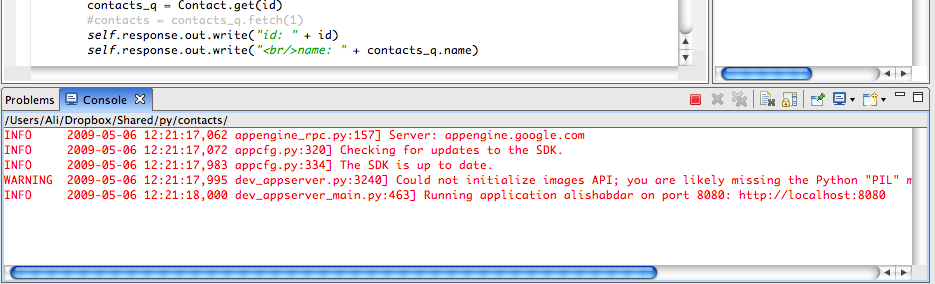
  6. Click Apply and then Run the application. You should see the application server run log in the Console window.

Running the appserver from within Aptana
Figure 5

Congratulations. You can now enjoy the power of Aptana while developing for Google AppEngine.

P.S. Special thanks to Joscha Feth because I benefited greatly from his article.

government,politics news,politics news,politics

An Open Cloud – Or Is It?

by Ali. 0 Comments

This is an article posted on CloudAve.

As you might know the Open Cloud Manifesto debuted on March 30st.

It outlines the pillars of Cloud Computing as well giving a brief on what the possible threats and weaknesses could challenge the early and future adopters.

The manifesto declares 4 major goals of an Open Cloud:

  • Choice; to give total freedom to the cloud clients in choosing between different cloud providers with no barriers
  • Flexibility; to maximize the interoperability between Clouds and organizations on different Clouds.
  • Speed and Agility; to employ open interfaces to allow organizations to build solutions that easily and quickly integrate

Read the full story

government,politics news,politics news,politics

How SaaS can impact the Middle East market

by Ali. 1 Comment

Middle East is usually behind when it comes to the bleeding edge technology. Clearly because we don’t build bleeding edge technology unless we are US or EU residents!

One of the greatest aspects of Cloud Computing is SaaS (Software as a Service). With the current credit crunch creeping all over the world, this might be biggest chance for SaaS to take a big leap and make itself ahead of the game.

However is it like that everywhere? Or is it just in US and Canada?

The point is that Middle East market is so overwhelmed by Microsoft supplied software that there seem to be no room to breath for alternatives. Windows is a reigning champ on both client and server systems, Exchange is there with no competitor, and Office is a no-brainer choice. In higher market levels you see Oracle and SAP ruling.

You might say, duh, this is pretty much the case everywhere, the situation here is more intense. The local market is so addicted to such products that I think it will take another 2 to 3 years for it to wake and see the world is a better place with SaaS.

However there are some constraints too. In a perfect world, SaaS applications would work just fine replacing the sluggish, pricey, and hard to maintain  applications.

But here is the thing: What if we can’t rely on the local Internet connection? UAE (where I currently live) has the best Internet facilities and biggest user share in the region, but we experience total blackouts one or twice a year due to “unforeseen circumstances”.

Well, I don’t need to say that what will happen to my cloud-based business if my US-hosted SaaS application goes down for a day.

In the other hand, there a lot of political and economic tensions between this part of the world and the rest of it! The security risk does matter and if a Middle Eastern firm totally relies on an overseas SaaS platform, what could be the guarantee for this not be used as a potential pressure factor?

Perhaps local and private SaaS platforms could be the best solution, but Private Clouds have their own merits and demerits.

Whatever the ups and downs of moving to the Cloud could be, the companies in the region, especially government and enterprises should have a close look at what is currently happening up in the Cloud.

government,politics news,politics news,politics