
Schrödinger’s data
The Schrödinger’s cat thought experiment illustrates a paradox where a cat in a closed box is both alive and dead until observed. As much as it irks me, a cat lover, to imagine a dead cat in a box I cannot see the inside of, I can’t help drawing a parallel between the cat and the data many small businesses sit on.
Data that is not observed is as good as nonexistent. That makes it a liability at best and an existential threat at worst.
Most small businesses don’t have a data problem. They have an observation problem.
The quadrant of (not) knowing
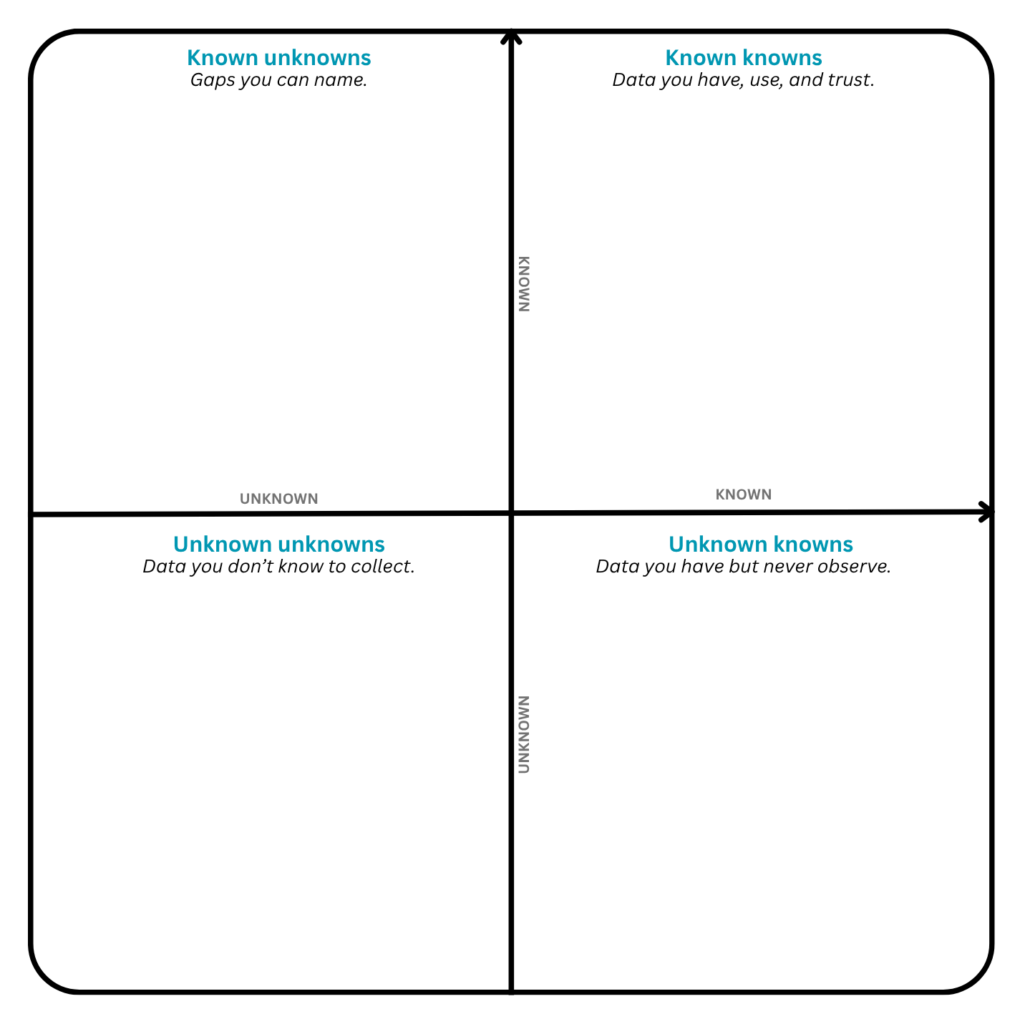
Borrowing from Donald Rumsfeld’s famous “knowns” framework, let’s draw a quadrant of knowns to map where the observed or unobserved business data fall.
The known knowns
These are all the data you know you have and need and can make sense of. These are your business software reports that either come out of the box or you ask the vendor to build them for you. Periodic sales reports, campaign leads, income statements, inventory reports, and employee attendance are among the known knowns.
The known unknowns
The information you know you need but failed to collect falls in this bucket. For example, you know there is customer churn in your business, but you don’t have the detailed churn data. Or you have access to the complete sales data, but it can’t be segmented by demographics due to the privacy regulations in your market. Also, there are times that your marketers can’t tell whether certain leads came from social media campaigns or costly OOH billboards. In such cases we are well aware of what we don’t know.
The unknown knowns
These are important but often ignored or overlooked data sitting dormant and scattered across your systems. Old financial reports sitting still in legacy accounting software, forgotten campaign data divided into two islands on your sales CRM and marketing automation software, or the detailed POS data on a third-party portal no one cares to log into. You collect all the transactional data and log the smallest change across your systems, but what good does it do for your decision-making?
The unknown knowns inadvertently blindside you and turn into a creeping business risk. Not having the full picture means that, for instance, your analytics software won’t be able to connect the dots between the open/click rates of a certain email campaign and the open/close trends of support tickets. The data you are so diligently collecting is telling you nothing.
The unknown unknowns
The most devastating unknown is the data you did not know you should be collecting to generate the intelligence vital to your competitiveness and the longevity of your business.
The seasonal buyers’ behavior that went undetected, for example, could severely impact your JIT supply chain. Or, dismissing macroeconomic trends, such as seemingly unrelated tariffs and geopolitical conflicts that lead to global economic catastrophe, cannot be ignored in this, like it or not, globalized world. And the ignored market intelligence indicating that competitors are abandoning a previously best-selling but now lackluster product will have you still ordering it in bulk for the holiday season.
Failing to observe any of these sources of data can push your cash flow to the point of no return.
The high cost of not observing
Unobserved data might seem like a benign business problem, often buried under a heap of “urgent” ones. A resource-strapped small business will almost always end up dealing with the “urgent” first. However, what’s at risk is anything but negligible. Any internal or external force that impedes the growth of your business at any given time is considered a risk. Unobserved data carries three major risks: business, security, and privacy and compliance.
Business risk
Data, when stored and observed properly, is an invaluable asset for reliable analytics and long-term growth. When it is left unobserved, however, you are painfully blind to its existence and the value it can generate.
Imagine you left the churn data to bleed out unobserved in Q1. If you are somewhat lucky, you’ll wake up to the problem in Q2 planning to take action only to realize that it is your slowest quarter. You will have less than six months to catch up to the end-of-year targets.
Your unobserved data is your competition’s best friend, acting as friction that slows you down, or worse, sends you off track. Any of the “unknowns” we discussed above causes data analytics to show an incomplete view of reality, clouding your judgment, while the competition is laser-focused toward success thanks to reliable predictive analytics.
Security risk
As the business data grows exponentially and organizations hoard data in unprecedented volumes, managing it becomes a daunting task by itself. In the past two decades, cloud computing has brought about capabilities to small businesses previously reserved for the enterprise. Cloud storage has increased in size and speed while reducing “IT” costs, sometimes dramatically, making dumping data on a third-party cloud and forgetting about it a no-brainer
But with growing capabilities come growing problems. Unobserved and unattended data scattered across different software and physical and virtual machines, often in geographically distributed locations, poses a new type of security risk.
If your IT folks are not vigilant enough, your business data can disappear, get compromised, or be taken for ransom at any given moment. What’s worse than any of this happening to your “known” data is if it happens to your “unknown” data. That’s like a leaky pipe hidden behind a seemingly spotless wall turning harmless drops of water into a flood waiting to happen.
Privacy and compliance risk
Collecting information about your customers helps you serve them better. However, holding onto your customers’ (often private) data means that you need to be meticulous with how it is stored and used.
No thanks to all those who misused customer data in the past, a set of stringent data protection and privacy regulations is now in place.
CCPA in the United States, for instance, provisions a maximum fine of $2,663 per unintentional violation and $7,988 for intentional ones. Each affected consumer can count as a separate violation, meaning that if you were found to be at fault for mishandling a small database of 10,000 customers, you could pay between $26 and $79 million in damages. Sephora paid $1.2 million in a 2022 CCPA settlement, and I bet they have an army of well-paid lawyers.
Similarly in Europe, GDPR can obliterate a small business with fines of up to €20 million. If your systems collect personal data from EU residents, your business could be exposed and in need of an urgent internal audit.
Compliance with law goes well beyond just the protection of personal information. Depending on your field or market of operation, you could be subject to more regulations and data-related nuances. Hoards of unobserved data lurking behind the walls of your organization are ticking bombs planted across your systems with the potential of costing you your business and livelihood.
Open the box
Schrödinger debated the state of an “unobserved” cat. Maybe the cat is not really there. Or maybe it is. In business, you can’t work with “maybes.” And our cat, Data, is far more consequential if left unobserved. The unobserved data won’t help you, but it certainly can hurt your business badly.
The solution here is not throwing yet another shiny piece of tech at the problem. The first step is to get intentional about seeing every bit of information that your organization possesses. You, the business owner or leader, have the power to open your eyes and start looking. The rest of the organization will follow suit.
When conducting (data) observation exercises with your team, it is important to start by grouping your organizational data using the (un)knowns quadrant we discussed earlier. You just need a pen and paper and your inspector’s hat on. I also made a downloadable PDF of the quadrant for you to get started today.
Good hunting!