
Now What? Turning the tables for your business in the dawn of crisis
“We must get it into our heads that our lives have changed.”
Dr. Francesco Menchise, Anesthesiologist
(on the cover of the Time Magazine, April 2020)
We are living through a painful and disruptive period in our lives. For the majority of us, this is the first threat of this magnitude. Not only does it threaten the health and wellbeing of our communities as a whole, but also the economic welfare of our global society.
No one seems to be safe from the immediate or long-term impact of the Coronavirus pandemic. It is a paralyzing catalyst for the demise of an already troubled global capitalism.
But one thing is certain:. This is a transitioning period. It is temporary, and we will have to eventually get out of our caves and into a brave new world.
What is that we must do in this transitioning period to not only survive in the post-pandemic world but also thrive in it?
These are not unprecedented times. There are many cases — lists of cases — where change, or something unexpected, has put many companies out of business and made other companies come out stronger and reinvent themselves.
The invention of the internet put many, many companies out of business; the ones who could not reinvent themselves for the Internet Age but rather doubled down on the old way they did business. Every video store is out of business because of streaming. When Starbucks moved into neighborhoods, many coffee shops went out of business. Not because of Starbucks, but because they refused to change the way they did business. Uber is putting taxi companies out of business — not because of Uber, but because the taxi companies refuse to change.
This is not unprecedented. More sudden? Absolutely. More shocking? Absolutely. But this is not unprecedented in the business world.
So for us to say, “How will we do what we’re doing?” but rather, “How will we do what we’re doing in a different world?”
And the world is different.
What is our prevailing mindset?
Are we in the fight or flight mode? Do we see loss, or do we see opportunity in the middle of all this chaos?
On April 20, 2020, when the oil futures dropped to a whopping minus $37.63 (yes it did), the first thought coming to my mind was of a disaster: dropping GDPs, a chain reaction in the global economy, and a whirlwind of negative intellectual thoughts.
It only hit me a few days later, that while the world was mourning the demise of oil, the oil tanker stocks went on a soaring frenzy, and still are. Focusing on the opportunity rather than the loss must have made a few investors very happy. And I was just a bystander biting my nails.
The world is currently changing so fast that practically no one can predict anything other than the fact that the global economy is on the brink of collapse. A new recession has started, and we might be in for another depression.
Looking at our humble and once-thriving businesses, how does our mindset impact the outcome? How are we writing the story of our businesses today, once this becomes history?
A mindset focused on the loss and driven by fear will cause us to:
- have a reactive or delayed response to rapid changes in the market
- rash cost-cutting and losing some of our most valuable assets, chief among them, key members of our team
- resort to protectionism and stop innovating, and
- ultimately lose most or some of our business and our livelihood.
On the other hand, seeking opportunities will help us:
- observe threats and prospects better and clearer
- quickly plan and execute change while restrategizing with agility
- diversify our products to match the current needs, and
- innovate and differentiate in ways that were not possible before.
In the time of crisis, more doors open than they close, but a few get to go through those doors successfully, and the majority will stand by the closed ones banging on them to no avail.
Meeting in the middle
Somewhere between seeing fear or opportunity lies in the risk of making a decision. No matter if we are fearlessly optimistic or fearfully pessimistic, we will have to make a call and jump. Where we land, however, will decide the fate of our business.
“The risk of a wrong decision is preferable to the terror of indecision.“ — Maimonides
So let’s make a calculated decision.
A 3 Step action plan
Start with a warm-up and reflect on the basics. Stay away from drawing conclusions too early and coming up with solutions that are likely to fail in the long run. There are no shortcuts.
First, Review your why (watch this timeless TED talk by Simon Sinek, even if you watched it before) together with your team. Bring as many team members as you can and revisit why you are in this business in the first place.
Then together, go on an internal observation tour, analyze current realities, and finally execute on your findings and your revised plans.
Set hard deadlines for all of these steps and consider that the clock is somehow ticking faster than it was before.
1. Observation
Identify the impacted areas of your business from a functional point of view. That is, getting granular into each function, e.g. marketing, sales, support, etc. beyond departments and divisions.
Look into the affected areas and see how the context of reality has changed for them after February 2020. The situation is quite fluid, and world events are happening at a staggering speed, but we can turn this speed to our favour.
In this new world, one factor remains a constant: Time is our biggest enemy and our biggest ally depending on which side you are standing.
Some common areas of impact are:
Marketing
- Budgets are slashed or frozen, and
- Some channels are no longer relevant, such as OOH ads, while some channels became more relevant, such as TV.
Sales
- There are no in-person meetings anymore, and fancy boardrooms are replaced with dull video calls, and
- Sales cycles are stretched to their limits and follow-ups are taking longer, while negotiations are taking forever.
Support
- The team is most likely working beyond capacity
- Customer experience has been impacted, and
- Employee experience is at an all-time low due to added pressure and social distancing.
HR
- Tracking attendance is not as straightforward or as accurate as before
- Team and individual KPIs are most probably changed with people now doing more work with less time
- Working from home (WFH) is impacting the physical and mental wellbeing of the employees, and
- Training and professional development programs, especially in-person sessions, have taken a hit.
IT
- Information management, governance, and compliance are under threat as teams are more distributed with little readiness
- Keeping the information and infrastructure secure is harder than ever before, and
- It is simply much harder to support the WFH teams with their daily IT requirements.
Operations
- Employee and customer safety have taken on a new meaning
- Adherence to ever-changing safety guidelines seems impossible while they hinder the performance of the various teams, and
- Logistics and supply chain channels are under extra pressure, while capacity issues create new bottlenecks.
Management
- The 2020 plans made last year are heading down the drain, and
- The company has entered the survival mode, which impacts every aspect of the functions listed above.
These are some of the most common scenarios. If you look deeper, you will find more areas of impact, especially where there are dependencies between functions or departments.
Mandate a Systems View
It matters to look at all these functions in a systematic and interrelated manner. Each one of these functions affects others either directly or indirectly. It may sound obvious, however, many organizations still have a siloed approach when it comes to day-to-day operations.
You can ask yourself when was the last time there was someone from HR sitting in a sales strategy meeting? Or, when the running a flash-sale on your website, were the support or logistic teams informed before the campaign started?
2. Analysis
To put the results of the observation exercise in a digestible and an actionable structure, we can use the good old (or dreaded, depending on how you look at it) SWOT analysis.
SWOT Analysis (SWOT, for brevity) is a powerful method that helps build your business strategy based on internal and external realities.
Typically, SWOT focuses on the Strengths and Weaknesses of your company, mostly from an internal perspective as well as Opportunities and Threats from an external perspective.
Why SWOT Now?
There is a good chance that you had done one or more SWOT when you started your business. You might even wonder why on Earth do we need to do another one in the middle of all this chaos.
Revisiting your SWOT, I would argue, is one of the best areas to start seeing the new realities clearly about your organization and put the areas of impact into perspective.
Better yet, it is beneficial to delve one level deeper and do a Functional SWOT. A Functional SWOT starts with focusing on different functions (and not departments) of an organization instead of looking at the organization as a whole.
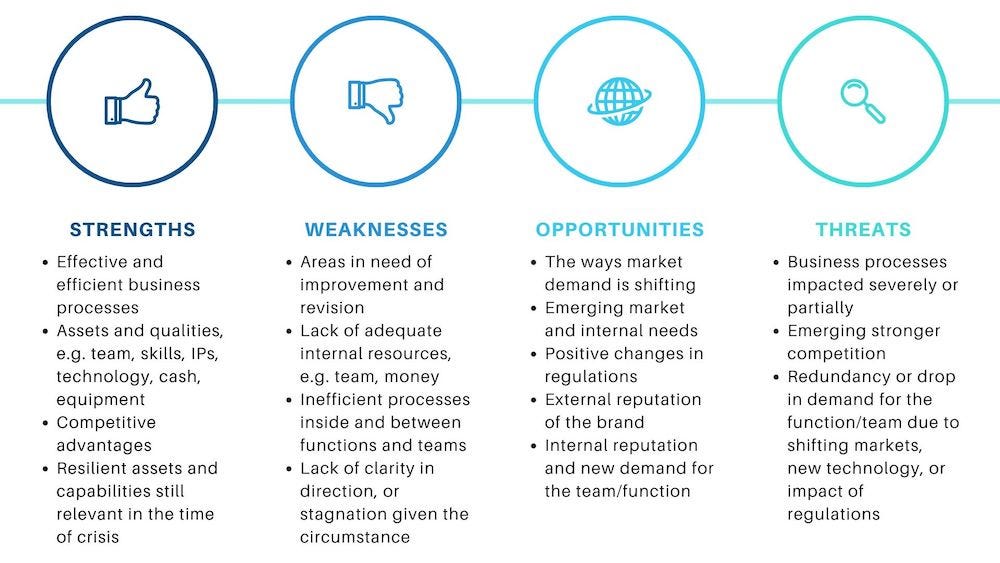
The key here is to analyze in the context of the current business and economic climate. Factors, such as uncertainty, cash flow, and market demand have been massively disrupted and need to be considered for the analysis to be as accurate and reliable as possible.
For instance, looking at Marketing as a function, you can evaluate what the new areas of strength and weakness are. Also, you can identify what opportunities were created recently, and what emerging threats impact your marketing efforts.
If you have a clear idea about the above, chances are that you will not make a quick decision to abolish the entire marketing budget overnight to save costs. If digital marketing was a strength of yours, it is now an even more critical asset.
If you look closer, you might find out that it is time to focus more on Account-based Marketing. This means that within the Marketing function, you will need to reallocate efforts and budget from mass emails and cold calls to key accounts while working closely with the Sales and Support functions.
Doing a SWOT within functions and keeping the respective teams involved and engaged will go a long way. The result of these Functional SWOT will then help improve the internal processes and collectively feed into an updated SWOT for the entire organization.
The outcome of this exercise will help you immensely to make decisions based on the current realities of the market and the internal realities of the organization. Taking a step back and doing a reality check by itself will give you an edge in the market.
For many, experiences and assumptions of the past coupled with anxieties of the present will be the guiding principle. In your case, however, it will be the validated information and hard facts that will show you the way.
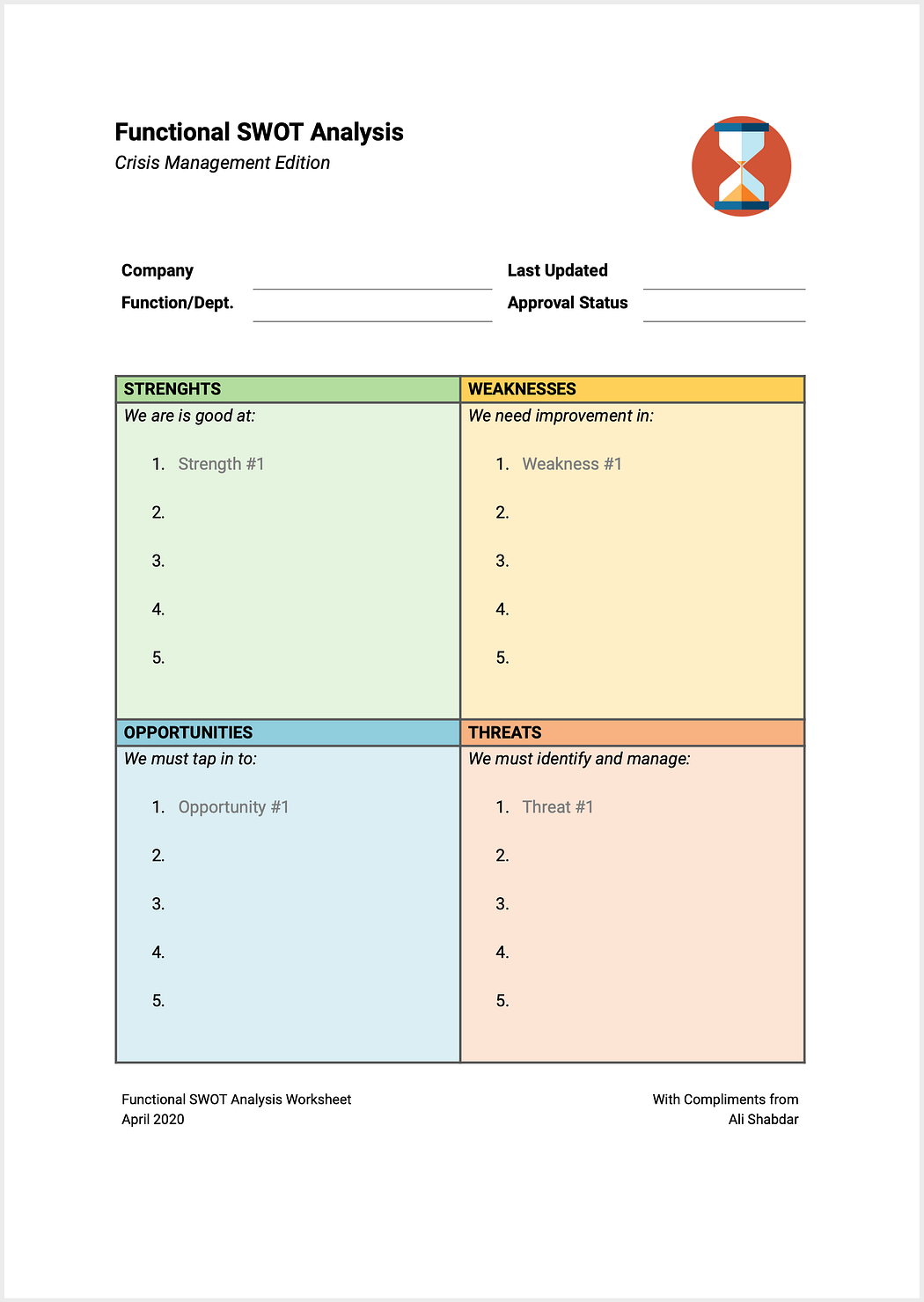
Resource: To help speed up the process and get you started today, you can download a Functional SWOT Analysis template here.
Use it as you wish.
Note: If you are wondering what that hourglass is doing on the top-right of the template, it is not a logo. It is a reminder of how important time is and how little of it we have to get our act together.
Diving even deeper: It is quite beneficial to do a PEST Analysis once you complete all the SWOT. Most of the political, economic, social, and technological factors have changed dramatically as well.
3. Execution
Once you completed the Functional SWOT and reached internal consensus and clarity, you can decide and act on what the next steps should be with more confidence.
Reallocating teams and resources to take advantage of strengths and opportunities while mitigating threats and improving on the weaknesses will be a natural next step.
Reviewing and improving processes should also be an integral part of the work. Now would be the perfect time to make them efficient and cut back on unnecessary steps or subprocesses. Identifying and giving priority to processes that impact the top line and bottom line one way or another is key to this improvement.
I must say, we are not talking about months and months of business process improvement (BPM) with consultants and thousands of pages of analysis and recommendations. If you are running a small business, you don’t have time for this nonsense, especially now. However, it is absolutely ok to take a few pages from the secret Book of Consultants and apply it here.
When it comes to business process improvement, two primary ingredients of success are:
- people, and
- technology.
People
People are still your biggest asset, now more than ever. Salaries and bonuses are a big chunk of the cost of running any business, and it is tempting to cut expenses by drastically reducing the workforce.
Downsizing impacts two key areas: customer experience and employee experience, both of which are tightly correlated.
Of course, when there is no business, cash is scarce, and the outlook of generating revenue is as clear as a foggy night, making hard decisions is inevitable. However, if you put on the paper the real value of your key people who keep the wheels spinning, chances are you decide to keep them on board for as long as possible.
People who bought into and got excited about your vision when they joined your company tend to stick around, share the risks with you, and help you make it back to the top again.
Technology
When it comes to efficiency, automation is king. Technology, when implemented and used properly, will help automate most of the cumbersome and resource-hungry tasks and free up resources to deliver real value for the customers and the organization.
Sure, launching a CRM sounds like a great idea, but it could be a daunting and expensive feat. A CRM can bring tangible value to the Sales function by making sure no lead falls through the cracks and the tedious admin work is done by the machine. This return will surely justify the investment.
Salespeople can focus on closing deals rather than sending hundreds of emails every day or remembering to follow up with a dozen prospects. A functional CRM will be a smart private assistant for the team. Moreover, it will help decision-makers to stay on top of the pipeline making the right decisions backed by facts instead of relying on gut feeling.
Transformation begins when technology works in harmony with people and processes to achieve tangible results better and faster.
Digital transformation has been a novelty for many in the past decade, an abstract concept that barely left the meeting room. For others, when it materialized, it was often a confusing mix of haphazardly implemented software systems that added to the troubles of the organization more than solving significant problems.

Time is now
In recent years, technology has become more accessible and affordable than ever. Cloud Computing is helping even the companies with little budget to tap into the computing power that was once only accessible to Fortune 500 companies.
The market needs have changed massively too. The speed at which modern society churns and consumes data today is incomparable to a few years ago. Artificial Intelligence (AI) and Machine Learning have found their ways into the most delicate parts of the operation of a typical business. Both consumers and employees are more tech-savvy, and advanced technology is a ubiquitous part of our daily lives.
Change is hard and often costly. There is no easier way to say this, but if your website was last done 15 years ago, and your client database is a spreadsheet saved on a desktop PC in the office, you are on the brink of extinction.
You might not need a behemoth server located in your headquarters or a complex ERP system to make things more complicated for your operation.
Streamlining your processes, relying on your core team, and buying software that you actually use will suffice for your company to pull off a successful digital transformation project. And you can do it in the midst of the crisis.
Make it happen
If you are a change-maker in your organization and have been pushing for kicking off a digital transformation project, you are lucky. There is no better time to have that conversation.
Here are some of the reasons:
Burning Platform: Digital transformation is no longer a nice-to-have; it’s a must. The urgency will lead to quicker internal response time and faster sign-offs.
Pivot Mode: Most organizations are at the crossroads of a complete pivot or less severely, fine-tuning current processes, products and services to match the current market conditions. This will need newer better technology.
Stronger Competition: Smaller competitors will have to quickly adapt to new realities. Those who are won’t do it quickly enough will disappear and be replaced with stronger ones. You will need to stay ahead.
Virtual Meetings: No matter how much you dread video calls, everyone is nowadays available to jump on a quick call and discuss ideas and make decisions.
Resistance to Change: People are in survival mode, and most will put the ego or complacency aside, try and play nice when it comes to change. Involve everyone and make them feel included and influential in what might be the most important project of your tenure.
Summary
Let’s revisit what we covered.
?What is our prevailing mindset: Loss or Opportunity? Seeing the world with a mindset of opportunity will open up hidden doors to places few have gone.
Time is of the essence, and inaction or fear-based decisions will prove perilous.
Take a quick and effective 3-step approach and get to work:
- OBSERVE: Which areas/functions in your organization are impacted, and how?
- ANALYZE: Perform a Functional SWOT Analysis for each function in the organization; What do the outcome of these analyses tell us?
- ACT: Put Digital Transformation on overdrive; Time is now.
Take care of your people, and they will take care of you.
State-of the-art technology without the proper processes in place and the right people at the helm, is just painful overhead expense in your balance sheet.