The age of artisan people
For most of human civilization, bread has been made by hand using the same rudimentary methods. The 20th century gave rise, among many other things, to the industrialization of bread-making. The “sliced bread” era had begun. Another push was in the 1960s when bread-making machinery dramatically sped up the production.
Today, if you go to any supermarket or hypermarket, you’ll see 100s of reasonably priced brands, shapes, and flavors of bread, pre-baked, pre-packed, and pre-sliced for you to pick from. Walls of bread. Literally.
Positioned farther from the bread aisle, often in a more “premium” corner of the shop, there is a small section dedicated to freshly baked and sometimes labeled artisan bread. With the promise of premium bread comes premium pricing, and some customers will happily pay for that.
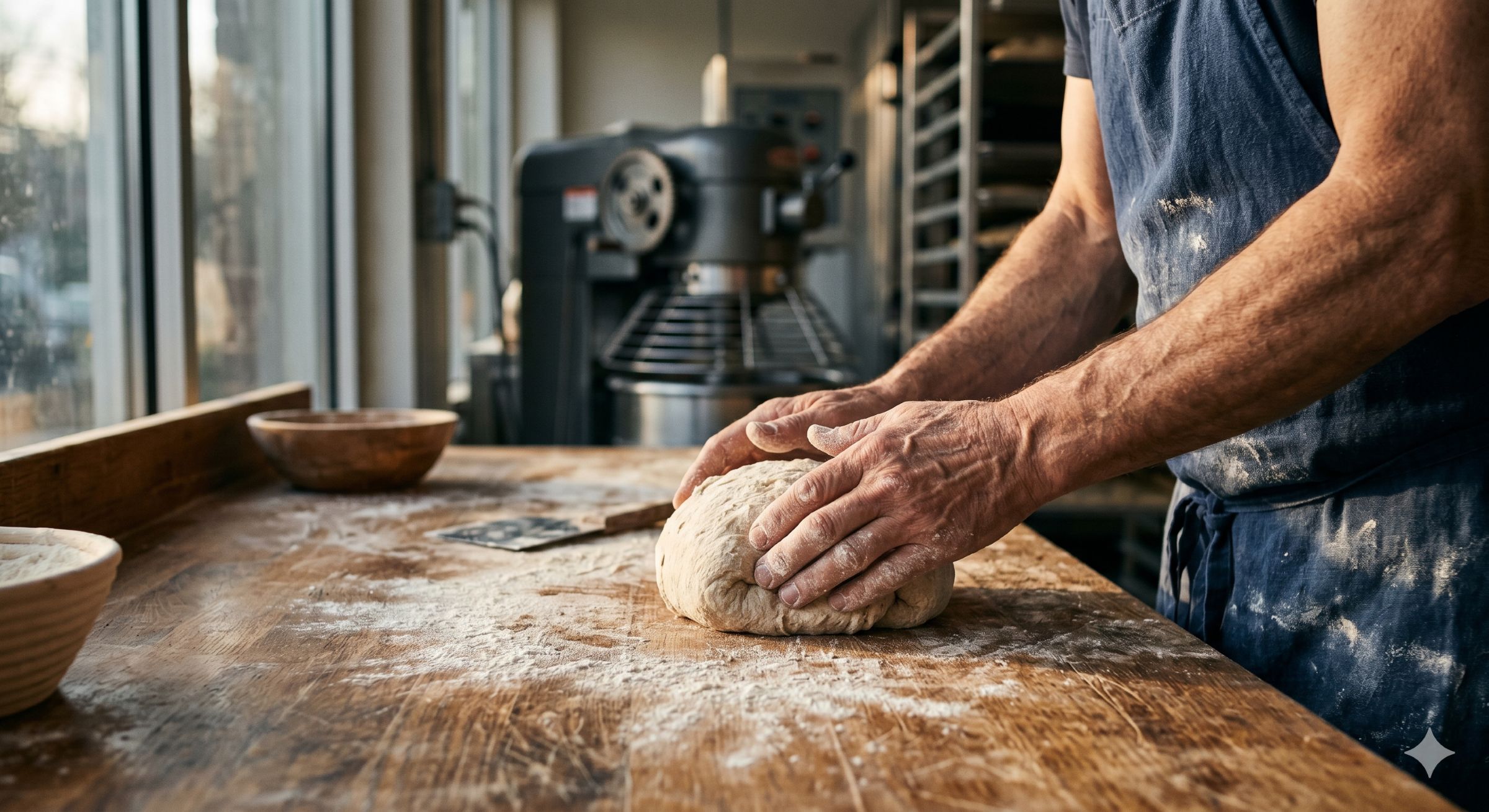
Another step up the premium ladder, and less available to the masses, are neighborhood bakeries, some of which wear the word “artisan” with pride on their signage. There, the intoxicating scent of freshly baked bread with quality ingredients and often made “by hand” combines with an inviting ambiance, making it effortless to justify paying the premium, sometimes up to 5 times the price of an average loaf of bread. That hefty premium is partly due to better ingredients and manual labor and mostly for the overall experience of buying an artisan product.
Flying through one industrial revolution after another while climbing Maslow’s hierarchy of needs, we once again are yearning for the human touch. So what happens when the same pattern plays out, not with bread, but with the humans we hire?
A similar trend is emerging in the job market, and it will gain momentum—one that will be difficult to ignore, making it a competitive advantage for those who pay attention.
Knowledge and service economies are going through a brutal disruption by AI, and it’ll only get more brutal from here. However, the need for the human touch in areas where it is currently a key part of the job will only intensify.
When experience becomes the product, something that CX experts championed for more than a decade, our species still has an edge. This edge is a scarce commodity, and it will be less and less available amid our insatiable AI-driven productivity run. Scarcity drives premium value, and AI is doing to people what industrial bread-making did to bread.
Enter the age of artisan people.
Sawubona
No one wakes up in the morning looking forward to getting on a call with the support department and seeking help for the problem they are facing using a product or service. You need to reach a point of frustration (and sometimes desperation) before picking up the phone and dialing that dreaded 800 number or looking for the chat option on a vendor’s website. That experience is often met with more frustration once you realize you are dealing with an often not very intelligent artificial intelligence. Designed often as a moat between you and a human operator, or dressed up as a CX initiative, most bots still don’t impress.
There will be an inflection point, and not in a distant future, when many people will be willingly paying a reasonable premium to access the “press 0 for a human” option. Human scarcity will demand a premium, one that the market can tolerate.
This is not merely because people hate talking to dumb bots; it’s because they want to be seen. They need to be seen and acknowledged. We want to feel that we matter, regardless of the context.
In Zulu, hello (Sawubona) literally means “I see you.” This gives me goosebumps every time I remember it. So far, bots don’t give that vibe. And people care about how you make them feel.
“I’ve learned that people will forget what you said, people will forget what you did, but people will never forget how you made them feel.”
― Maya Angelou
The verdict is in.
Medallia’s 2026 State of Customer Experience report found that more than two-thirds of consumers believe AI-driven service will handle basic needs, while human touch will become a feature of premium experiences. (CX Dive, 2026)
A Five9 survey of 4,000 consumers found that 75% prefer talking to a real human for customer support, while 56% are often frustrated by AI chatbots, and 48% don’t trust information provided by AI-powered bots. (Five9, 2024)
Nordstrom is leaning into human care, with their senior director of customer care stating, “The biggest thing for us is really about the human connection.” (CX Dive, 2026)
In the future, any profession requiring deep emotional involvement where the customer needs to feel heard, seen, and acknowledged will enjoy a new revenue stream, a premium that will only grow. Think concierge, therapy, life, and business coaching. These will see an uptake in premium tiers performed by humans and only be empowered by AI. The future still belongs to Homo Artifex.
We are in the middle of, perhaps, one of the most consequential transitions in human history. Technology helped create the knowledge economy, and now it is helping to upend it. The shift from the status quo to the next stage of human progress is happening so fast we need new skills and a new paradigm to weather it and come out on the other side standing.
Embracing two crucial realities will help us prepare for the imminent future and stay ahead of the majority: 1) empowering and augmenting ourselves with AI, and 2) doubling down on utilizing our unique human qualities as our differentiator against the rise of the machines and, yes, fellow human beings alike.
When the market decides what’s artisan and what’s commodity, which side of that line will we be on?